Welcome to our Steel Worlds Industries

E-mail us
steelworldsindustries2018@gmail.com
Stainless Steel Flanges
Stainless steel Flanges are widely used in both domestic and industrial applications because of the various benefits it offers. It is resistant to corrosion and temperature and appearance is good. The flanges made of stainless steel offers all these benefits and many more. Stainless steel flanges are important in industries like transport, gas, water, food, beverage, chemical process etc where piping is required these flanges are used for connections. Flanges are important part of the piping connection and also provides easy access for cleaning, inspection or modification.
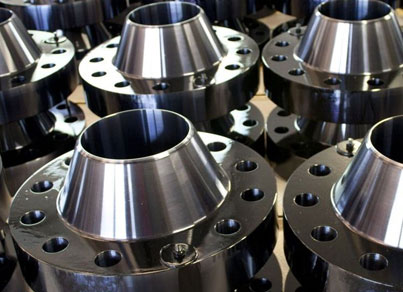
| Standard | ASTM A182 |
| Type | Weldneck, Slipon, Blind, Socketweld |
| Grade | 304, 304L, 304H, 310, 310S, 316, 316L, 316ti, 317, 317L, 321, 347, 904L |
| Size | 0.5” to 24” |
| Class | 150#, 300#, 600#, 900#, 1500# |
Duplex Steel Flanges
Duplex flanges are made from an austenitic-ferritic stainless steel, which was designed to deliver higher strength and corrosion resistance than other 300 series stainless steel flanges. It helps users to avoid stress corrosion, cracking that is typically seen with 316 and 317. The advantages of duplex stainless steel – higher strength, better fatigue properties, high resistance to chloride stress corrosion cracking etc.
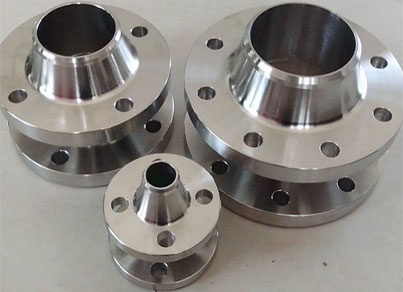
| Standard | ASTM A182 |
| Type | Weldneck, Slipon, Blind, Socketweld |
| Grade | F51 (31803), F53 (32750), F55 (32760), F61 (32261) |
| Size | 0.5” to 12” |
| Class | 150#, 300#, 600#, 900#, 1500# |
Weld Neck Flanges
A welding neck flange (also called a 'weld neck flange') is well recognised for its long-tapered hub, which provides mechanical strength (useful to resist 'dishing' and 'bowing').Weld neck flanges are used in applications where the conditions are severe and critical. Welding neck flanges are high integrity flanges and are available in all sizes, all common face types (flat, raised, RTJ), and all classes. Some of these conditions include high pressure, wide fluctuations in temperature and pressure, high temperature, fluids that are volatile and hazardous, and temperatures in the sub-zero range.
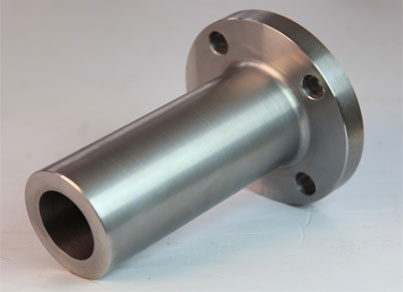
| Size | 0-1 inch, 1-5 inch, 5-10 inch, 10-20 inch, 20-30 inch, >30 inch |
| Material | Stainless Steel |
| Finishing | Bright,Polish |
| Material Grade | Stainless Steel |
| Material Standard | ASTM A182 |
| Condition | New |
Threaded Flanges
Threaded flanges can be fitted to pipes of various sizes without welding and this is one chief benefit for which these flanges are highly demanded. They can be used in extremely high pressure applications, particularly at or near atmospheric temperature, where the necessary post weld heat treatment is not possible.There are several different types of threaded flanges available on the market today. These include Slip On (SO), Socket Weld (SW), Lap Joint (LJ), Blind (BL), Weld Neck (WN), Orifice (OR) and Long Weld Neck (LWN)flanges.Threaded connections are almost the polar opposite of flange connections.
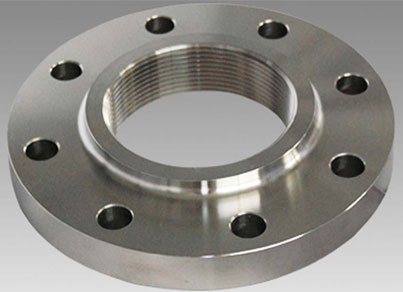
| Standard | ASTM A105, ASTM A182 |
| Material | Carbon Steel, Stainless Steel, Alloy Steel |
| Size Range | 1/2'', 1'', 2'', 3'', 4'' to 24' |
| Pressure Class | Class 150 to 2500 |
| Face | Raised face (RF), Ring type joint (RTJ) |
| ISO Certified | Yes |
Socket Weld Flanges
Socket-weld pipe flanges are typically used on smaller sizes of high pressure pipes. These pipe flanges are attached by inserting the pipe into the socket end and applying fillet weld around the top. This allows for a smooth bore and better flow of the fluid or gas inside of the pipe. Socket weld flanges are designed for small nominal pipe sizes (≤ 4 inches, ≤ 10cm) and are common for ½ to 2-inch pipe sizes (1.3 to 5cm pipe sizes). The mechanical strength of a socket weld flange is similar to that of a slip-on flange, but the slip-on flange may use two welds. The ASME B31.The main use of flange is to connect pumps, pipes, valves, and other equipment to make a pipework system.
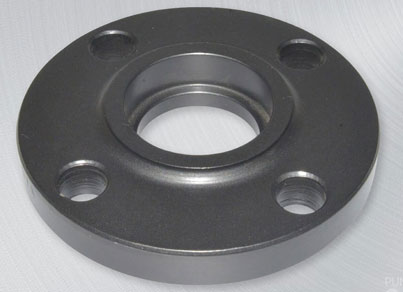
| Standard | Carbon steel ASTM A105, ASTM A350 LF1/2, ASTM A181 Alloy steel ASTM A182 F5, F9, F11, F22, F91 Stainless steel ASTM A182 F304/L, F316/L |
| Outer Diameters | 1/2 inch to 24 inch, up to 2500# |
| Special made | 24'' to 60'', up to 900# |
| Wall Thickness | Schedule 40 to 160 |
| Pressure Ratings | Class 150 to Class 2500 |
| Face Type | RF, RTJ |
| ISO Certified | Yes |
Slip On Flanges
Slip-on flanges are most commonly used in water systems, oil and gas pipelines, air conditioning systems, cooling towers, and other piping applications. They provide a secure connection between two pipes that can withstand high pressures without leaking or coming apart at the joints. Slip on flanges are a popular type of pipe flange designed to accept pipe into the bore/center of the flange for welding around both the Outer Diameter (OD) of the pipe and on the interior side of the connection. The calculated strength of a Slip On Flange under internal pressure is about two thirds that of a Weld Neck Flange, and their life under fatigue is about one third that of a Weld Neck Flange.
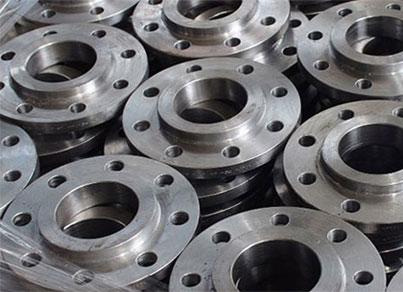
| Standard | ASTM A105, ASTM A182 |
| Material | Carbon Steel, Alloy Steel, Stainless Steel |
| Size | 1/2'' to 24'', customized up to 60'' |
| Pressure Ratings | Class 150 to Class 2500 |
| Face Type | RF, RTJ |
| Common outer diameters | 1/2'', 2'', 3'', 4'', 6'', 8'', 10'', 12'', to 24”. |
| Class range | Class 150, Class 300, 400, 600, 900, 1500, 2500(# or LB). PN 2.5 to PN 250. |
Lap Joint Flanges
The lap-joint flange and stub-end assembly are used mainly in piping systems that necessitate frequent dismantling for inspection or routine maintenance. It is also used in the erection of large diameter or hard-to-adjust piping configurations because of its quick bolt hole alignment. These flanges are available in common dimensions like other flange types making it easy to integrate them into existing piping systems or use alongside other piping components. These flanges are available in common dimensions like other flange types making it easy to integrate them into existing piping systems or use alongside other piping components.
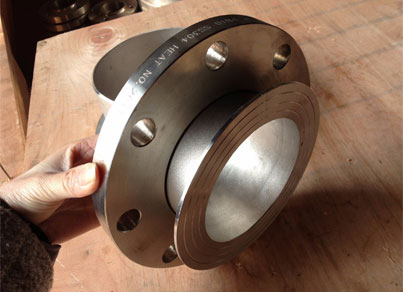
| Material | Carbon steel: ASTM A105, A350 LF2 Stainless steel: A182 F304/F304L/F316/F316L/F321 Alloy steel: ASTM A182, GR F1, F11, F22, F5, F9, F91 |
| Dimensions | Common Outer Diameters: 1/2'' to 24'' Wall Thickness Schedule: SCH 10, SCH 40, SCH 160 |
| Standards | ASTM A105, ASTM A350 LF2, ASTM A182 F11, F22, F304, F316 |
| Testing Standard | ISO 5208 |
| ISO Certified | Yes |
| Ends | Flanged End |
Blind Flanges
A blind flange (also called a 'closure plate flange') is installed at the end of a piping system to terminate a pipe. It has no centre hole (bore), so there is no flow through the flange. A blind flange may be used for isolating a pipe, valve, or pressure vessel. A blind flange is a solid disk used to block off a pipeline or to create a stop. Similar to a regular flange, a blind flange has mounting holes around the perimeter and the gasket sealing rings are machined into the mating surface. The difference is that a blind flange has no opening for fluids to pass through.
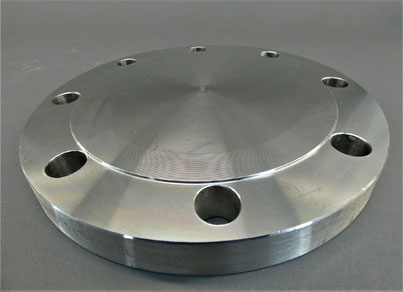
| Material | Carbon, Alloy and Stainless Steel |
| Standards | ASTM A105, ASTM A182. |
| Sizes | 1/2'' to 24'', Customized up to 48'' |
| Thickness | Schedule 10(S) to SCH 160 |
| Pressure Ratings | Class 150 to 2500 |
| Face Type | RF, RTJ |
| Dimensions | General use OD range: 1/2'', 2'', 3'', 4'', 6'', 8'', 10'', 12'', to 24”. Special made OD: Up to 60”. Class range: Class 150, Class 300, 400, 600, 900, 1500, 2500 Flange face type: RF (Raised Face), RTJ (Ring Type Joint) |
Carbon Steel Flanges
Carbon Steel Flanges are pipe connectors that join two pieces of piping together. They are made using carbon steel material and contain a raised lip or rim that ensures a strong bond is formed between the pipes by welding them together. Furthermore, they are designed to support greater pressure due to their stronger construction. These metallic connections also provide moderate corrosion resistance, making them ideal for industrial & general purpose applications.
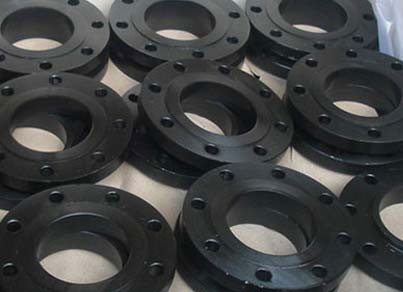
| Standard | ASTM A105 |
| Type | Weldneck, Slipon, Blind, Socketweld |
| Size | 0.5” to 24” |
| Class | 150#, 300#, 600#, 900#, 1500# |